Genetic risk factors for postoperative complications after major surgery
Serious complications after major surgery are common, but it is not always clear how far they reflect the immediate stress of surgery versus a person's underlying susceptibility to the same condition outside the postoperative period. In a medRxiv preprint, Richard Armstrong and colleagues use UK Biobank genetics to examine this question for five common postoperative complications.
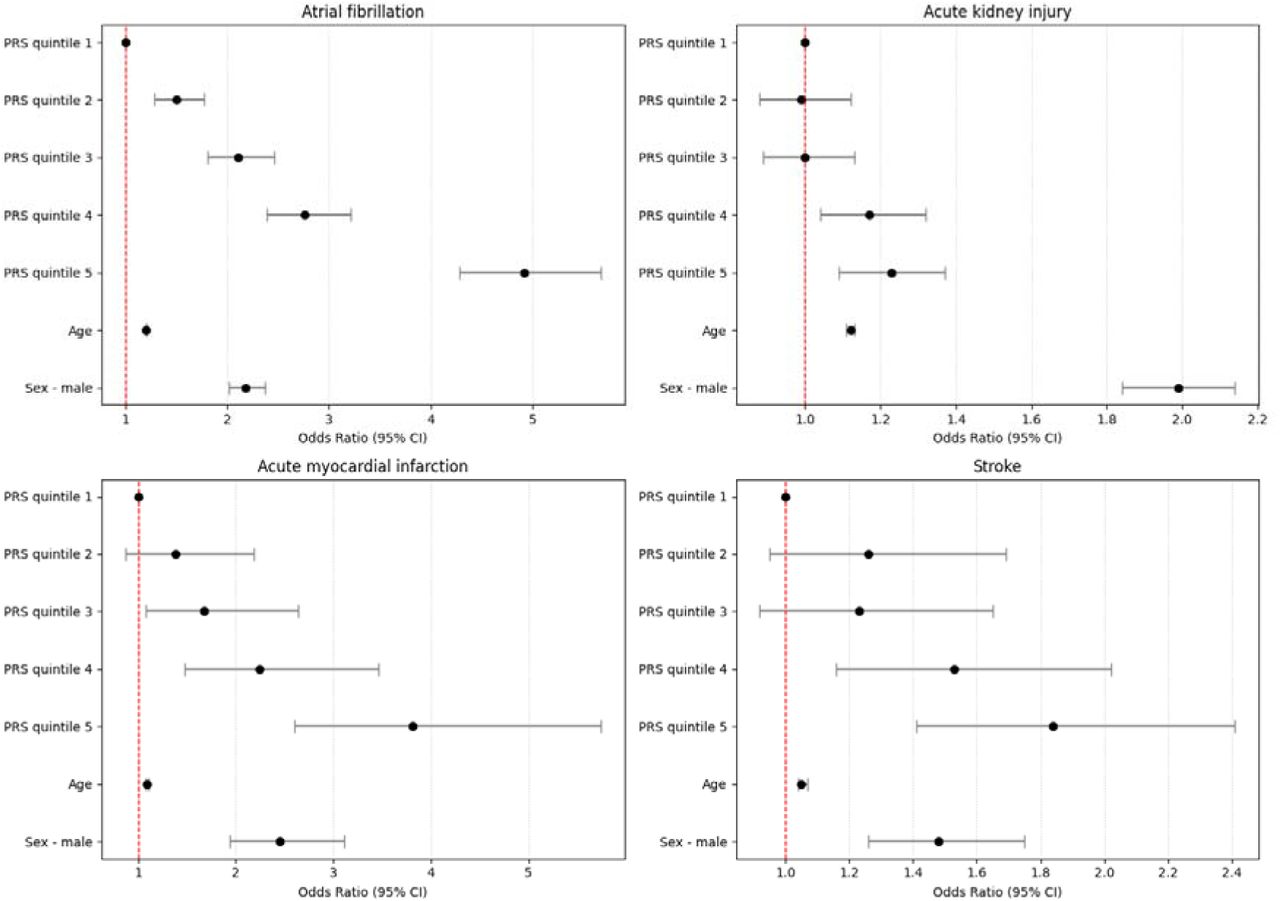
Figure: Association between postoperative complications and increasing polygenic risk score quintile for related non-postoperative phenotypes. Source: Armstrong et al., medRxiv, 2025, Fig. 4 (CC BY-NC-ND 4.0).
Background
Postoperative acute kidney injury, atrial fibrillation, myocardial infarction, stroke and surgical site infection are clinically important outcomes. For some of these, there are well-established genetic risk factors in non-postoperative settings. The question is whether postoperative events share that genetic basis, or whether the perioperative setting has a distinct genetic architecture.
What the study did
The study performed case-control genome-wide association studies in more than 140,000 UK Biobank participants who had undergone major surgery. The primary outcomes were postoperative acute kidney injury, atrial fibrillation, myocardial infarction, stroke and surgical site infection.
The authors then compared postoperative outcomes with their non-postoperative equivalents using genetic correlation analyses and polygenic risk scores derived from non-postoperative disease phenotypes.
What this adds
Among 8,472 postoperative complications in 140,563 eligible participants, the clearest genome-wide findings were for postoperative atrial fibrillation. The study identified risk loci on chromosomes 1, 4 and 16, including loci near KCNN3, PITX2 and TRAF7:CASKIN1.
The paper also reports strong genetic correlation between postoperative and non-postoperative atrial fibrillation. Polygenic risk scores for several non-postoperative phenotypes, including atrial fibrillation, myocardial infarction, stroke and chronic kidney disease, were associated with increased odds of the corresponding postoperative complication.
No genome-wide significant loci were identified for postoperative acute kidney injury, myocardial infarction, stroke or surgical site infection in this analysis, which may reflect limited power, phenotype definition, or more complex biology.
Why this matters
The findings support a model in which at least some postoperative complications partly reflect underlying chronic disease vulnerability. That matters for perioperative medicine because risk prediction and postoperative follow-up may need to account for longer-term cardiovascular, renal and neurological risk, not only the immediate surgical episode.
This work is currently a preprint and has not yet been peer reviewed. As with many biobank studies of acute clinical outcomes, phenotype coding and case numbers are important limitations, and replication in other surgical cohorts will be needed.
Preprint
Armstrong RA, Yousefi P, Gibbison B, Khandaker GM, Gaunt TR. Genetic risk factors for postoperative complications after major surgery and shared genetic aetiology with non-postoperative phenotypes. medRxiv (posted 2025-12-12; version 2). DOI: 10.64898/2025.12.11.25342055.